
Council Bluffs Directory Shelves
Council Bluffs has overlapping collections, not one unbroken run. The Library Digital Archive provides free item pages, images, and PDFs for many volumes. Its visible run begins with 1866 and extends through 1979 with gaps. Missing years do not prove that no directory was printed.
| Collection | Years | Where Held | Access |
|---|---|---|---|
| Digitized city directories | 1866-1979, with gaps | Library Digital Archive | Free images and PDFs |
| PCGS city directories | 1866-1994, 1996, 1997 | Frontier Heritage Library | Visit, appointment, or email |
| PCGS telephone books | 1997-2016, 2020 | Frontier Heritage Library | Historical address clues |
| Local yearbooks | From 1897 | Library Iowa Room | On-site and selected scans |
| Daily Nonpareil | 1857-present | Library collections | Microfilm and databases |
The Pottawattamie County Genealogical Society inventory reaches later than the digitized run. Its broader shelf matters when an online sequence ends. Record scan coverage, shelf coverage, and publication history as separate facts.
Council Bluffs Directories Online
The digital city directories show changing publishers. Early labels include W.S. Burke in 1866, Bushnell in 1868 and 1869, Wolfe in 1869-70, Beach & Gwyer in 1871, and Corbett/Hoye in 1873-74. Later volumes include Hawley, D.C. Dunbar, McAvoy, and Polk. Browse near the target year because a person may appear in a business, resident, or street section.
The collection header and browse screen showed different item totals during research. Treat that count as changeable. The printed year is more useful, and labels such as 1880-81 should be copied exactly.
The digital collection screen shows the search route.
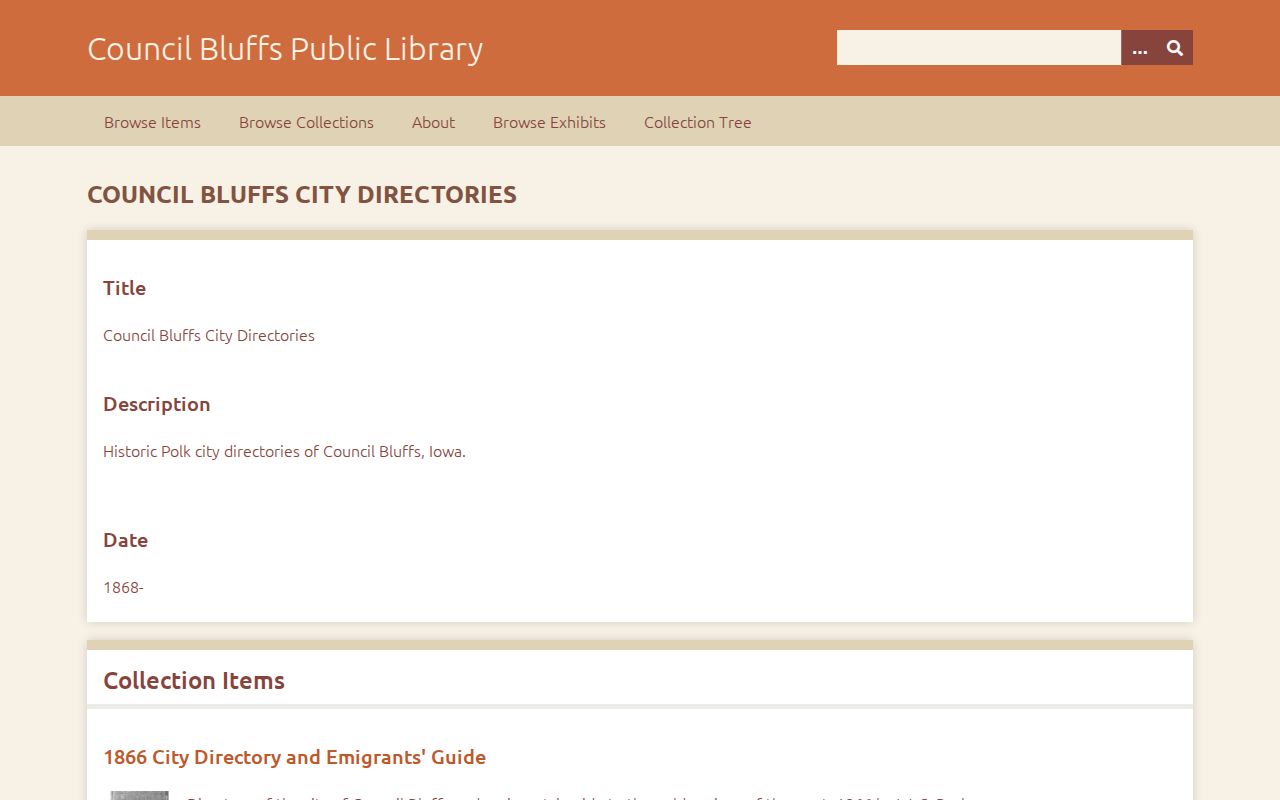
Open the item image or PDF after finding a volume. Save its address, title, year, and page.
Council Bluffs Iowa Room Access
The Public Library Local History service is the chief fallback when a scan is absent or faint. The second-floor Iowa Room has local books, microfilm readers, and genealogy records. Special Collections may require an appointment. The Reference Desk lists weekday research hours from 9 a.m. to 5 p.m. and (712) 890-5431 for appointments.
Ask for a year, title, surname, address, and likely page type. Other holdings include maps, church histories, photos, diaries, clippings, Nonpareil negatives, census material, cemetery records, newspapers, and obituary help. Some databases are available only inside the library.
Reading Council Bluffs Directory Records
A historic entry must be read from the scan, not guessed from archive metadata. A line may contain a name, trade, business link, and address. Some volumes add spouse, widow, boarding, or ownership marks, but notation changes. Inspect that volume's key first.
| Person or firm | Copy spelling, initials, and heading. |
|---|---|
| Work or trade | Note the printed affiliation without calling it a residence. |
| Street address | Keep number, direction, suffix, and unit. |
| Household mark | Check the key before interpreting it. |
| Citation | Save title, year, page, and item URL. |
- Criss-cross directory
- A section arranged by street or telephone number rather than surname.
- Householder index
- An address list linking a house to the person listed in that year.
- Abbreviation key
- The book's guide to shortened terms and symbols.
The 1868 Council Bluffs Volume
The 1868 Bushnell directory item identifies Bushnell's Business and Resident Directory of Council Bluffs, dated July 1, compiled by Joseph P. Bushnell, and created by the Nonpareil Printing Company. Metadata also notes a city and railroad map, a general review, houses, buildings, businesses, and addresses.
Those facts establish the book, format, coverage, and rights, but not a person row. Open the PDF and inspect resident, business, street, and key pages. Educational use is stated, while commercial distribution requires permission.
Note: Archive metadata and a scanned person entry are different records, and both need a citation.
Council Bluffs Directory Timeline
The directory shelf fits a wider record history. Older place names and publisher changes alter where a name appears.
| Period | Milestone |
|---|---|
| 1853 | Kanesville adopted the Council Bluffs name. |
| 1866 | The library's advertised directory run begins. |
| 1868 | Bushnell issued a dated business and resident snapshot. |
| 1897 onward | Yearbooks add class and organization clues. |
| 1997-2016 | PCGS telephone books extend later address research. |
| 2020 | PCGS lists another local telephone book. |
Rail growth from 1867 also guides newspaper and map work. Never project a modern spelling backward without checking a dated source.
Council Bluffs Directory Cross-Checks
A directory name gains weight when a second source supports the same place and time. Local yearbooks start in 1897. Daily Nonpareil material reaches 1857, and early Bugle issues are online through the Library of Congress. Fairview and Clark Cemetery clues can point toward death notices, though no complete city interment index was located.
The State Historical Society inventory adds deeds, probate, naturalization, court, census, vital records, transfers, and maps.
The official holdings screen helps plan archive work.
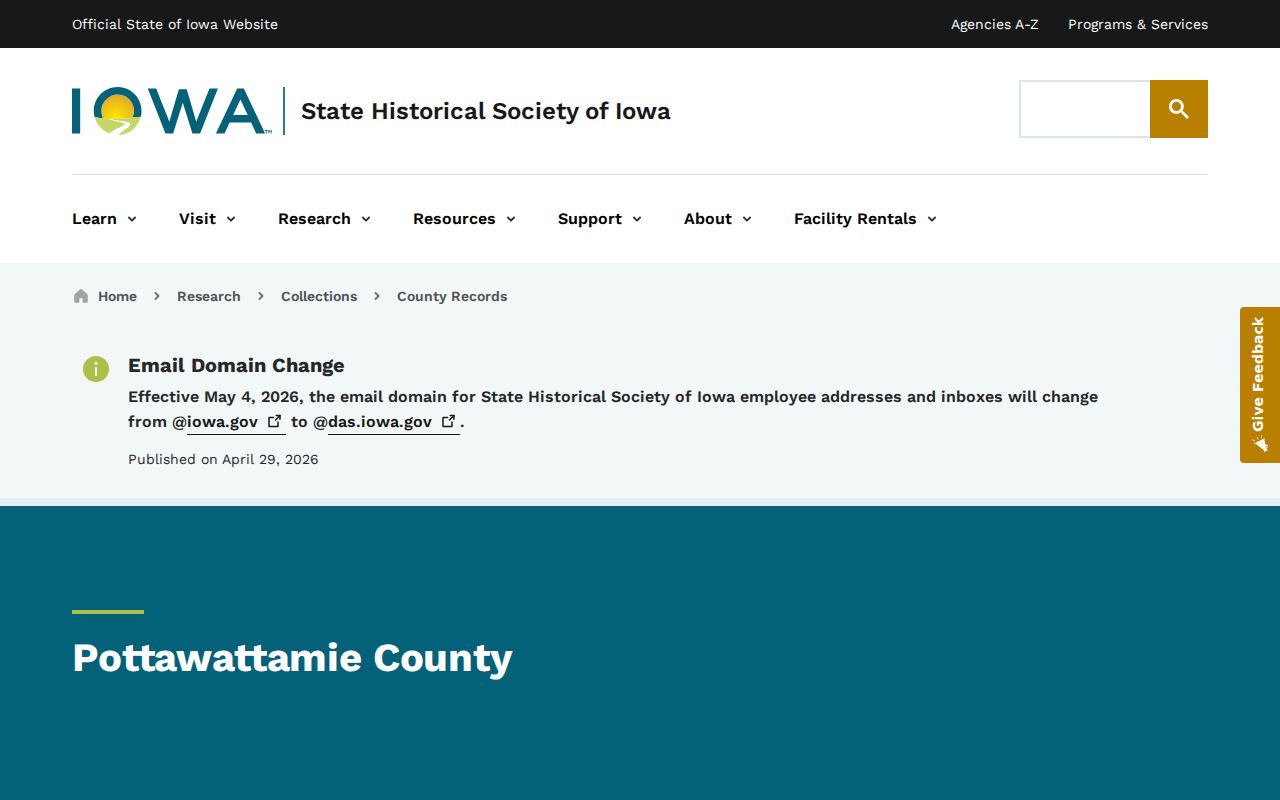
Its ranges identify likely series, not proof that a named person appears.
Kanesville Names in City Directories
Before January 1853, records may use Kanesville, Miller's Hollow, or Hart's Bluff. These are useful search keys for early newspapers, church records, deeds, and maps. Search a surname with each name and a narrow date.
The 1885 and 1896 Sanborn maps add block context. A map shows structures and uses, not a resident. Pair a sheet with a dated city directory and preserve the old address form.
PCGS Council Bluffs City Runs
The Frontier Heritage Library at 622 South Fourth Street is a distinct access channel, not merely a copy of the city library archive. The Pottawattamie County Genealogical Society advertises Tuesday hours from 10 a.m. to 3 p.m. and access by appointment. Email research requests are also possible, though no current official fee schedule was located. Ask about cost and scope before ordering work.
Its holdings include county censuses for 1852, 1856, 1885, 1895, 1915, and 1925, obituary files from 1896 forward, atlases from several years beginning in 1885, maps, surname files, legal files, and indexed society newsletters. These sources can test a city directory match when the resident's name changes spelling or the household moves between printed years.
Telephone books from 1997 through 2016 and 2020 are historical clues, not a live people list. Cite the precise book year. A telephone listing may be stale, omitted by choice, or tied to a business rather than a home.
Council Bluffs Newspapers Add Context
Directory entries are terse. Newspapers explain why a person or firm appeared at a certain address. The library states that Daily Nonpareil coverage runs from 1857 to the present through its local-history program. Chronicling America supplies digitized Council Bluffs Bugle issues from 1857 to 1868 and early Nonpareil issues from 1857 to 1867.
Search a full name with a street, employer, church, school, or event. Read nearby notices as well as the exact hit. An advertisement can confirm a business address, while an obituary may name relatives and burial place. Neither should silently replace the dated directory claim. Keep the newspaper title, issue date, page, and text beside the city directory citation.
For a classmate, the local yearbooks may be a better companion. They reach back to 1897 and can supply a photograph or school group, but they should not be used to infer a home address unless another record provides one.
Trace Council Bluffs Directory Families
Build a dated sequence from the nearest known address. Do not assume yearly publication, and never read a missing volume as proof of a move.
- Keep the original surname, direction, and street suffix.
- Check both name and street sections in the nearest year.
- Move to the next available scan, then ask PCGS about gaps.
- Pair listings with federal or Iowa census years.
- Test a disappearance with obituary, cemetery, probate, deed, or newspaper records.
- Save title, year, page, image link, and key meaning.
An occupant listing and deed owner can differ. For present property work, use the Council Bluffs street directory workflow rather than an old volume.